GlenDronach! Peated! I’m always fascinated by peated expressions of traditionally non-peated whiskies (which encompass almost all whiskies distilled anywhere other than the Islay region of Scotland), particularly when the whisky in question is one with which I am otherwise very familiar. My old calendar friend GlenDronach, as recently covered in Day 18, is an Advent stalwart, having shown up (quite successfully) four previous times in the last three years; those prior releases unveiled the bulk of GlenDronach’s core range, but all of them are entirely unpeated, making tonight’s further core entry a category of its own for the distillery. GlenDronach decided to release a Peated expression fairly recently as a nod to how the distillery used to make whisky back in the 19th century, although since its founding in 1826 it’s been a sort of rocky road until recently. Stop me if you’ve seen this kind of Scottish distillery timeline before: sold 1830, sold 1920 (to the son of the founder of Glenfidditch), sold 1962, mothballed 1996-2002 (not that long ago!!), taken over 2005 (by Chivas), taken over 2008 (by BenRiach, who makes some pretty awesome whisky in its own right and has presided over a highly impressive GlenDronach resurgence in the past 8 years), taken over (along with BenRiach) earlier this year (although so far the same folks have been left in charge). No job security in whisky-making.

The peating in GlenDronach’s first ever (modern-day) peated offering is done…pleasantly? Is that a thing? The peat effect is definitely noticeable, but far from in-your-face, adding aromatic traces of lantern oil, sweet compost, old leather and moss to GlenDronach’s stone fruit and florals, which are otherwise not lost or mellowed in maturation in this younger non-age-designated malt. The palate is similar, part oily and part sweet, either adding perfumed refinement to the peat’s underlying funk or adding some necessary grime to an otherwise potentially too-pristine Highland whisky, depending on how you look at it. The result is a little bit of everything: pistachio pudding, suede jackets, distress flares, car exhaust, marmalade, apple crisp…I could keep going. What a value at $83. Can’t wait to see what Christmas Eve has in store!





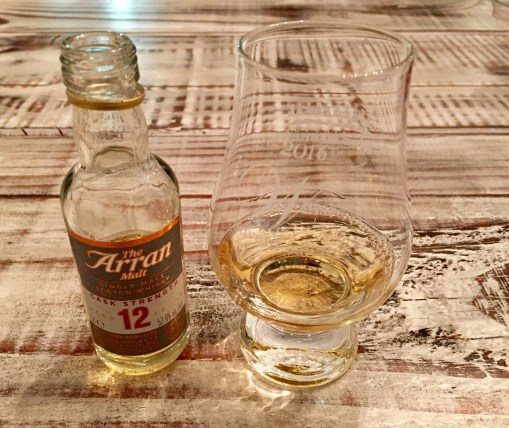 Arran is a traditional distillery with modern foresight, which releases a wide array of scotches aged in practically everything possible — current highlights include a Sauternes cask, a Port barrel and (!!!) an Amarone cask bottling. I love it. If you’re so inclined, you can also
 And it is, in spades, if you’re a fan of the Islay style of peated whisky. The Cask Islay contains 35 ppm of peat phenols, chemicals released in the smoke of burning peat moss used in the distillery’s kilns while drying malted barley which are absorbed by the barley itself. 35 ppm is not overly high as far as peated scotch goes; the peat bombs that push the issue can get all the way up to 200 ppm (at which point they basically taste like solid charcoal). But even the lower figure is enough to establish peaty dominance in the Cask Islay’s nose, all oily smoke, seawater brine, clamshells, beach fire pits, iodine and (weirdly) Comet cleaning powder. Happily, it is more personable to taste than to smell, adding warm peach cobbler and baked apple fruitiness to the swirling peat mass of shoe polish, diesel, sulphur and topsoil, finishing hearty and rich. This is a great fireside malt, although it would certainly not make a good pick for a whisky neophyte’s scotch initiation. Frankly a spectacular buy for any Islay lover at this price point. I’m in.






 cabernetdialectic (Raymond Lamontagne)
 Dan Steeves
 Peter Vetsch
 tylerderksen
 pop & pour